

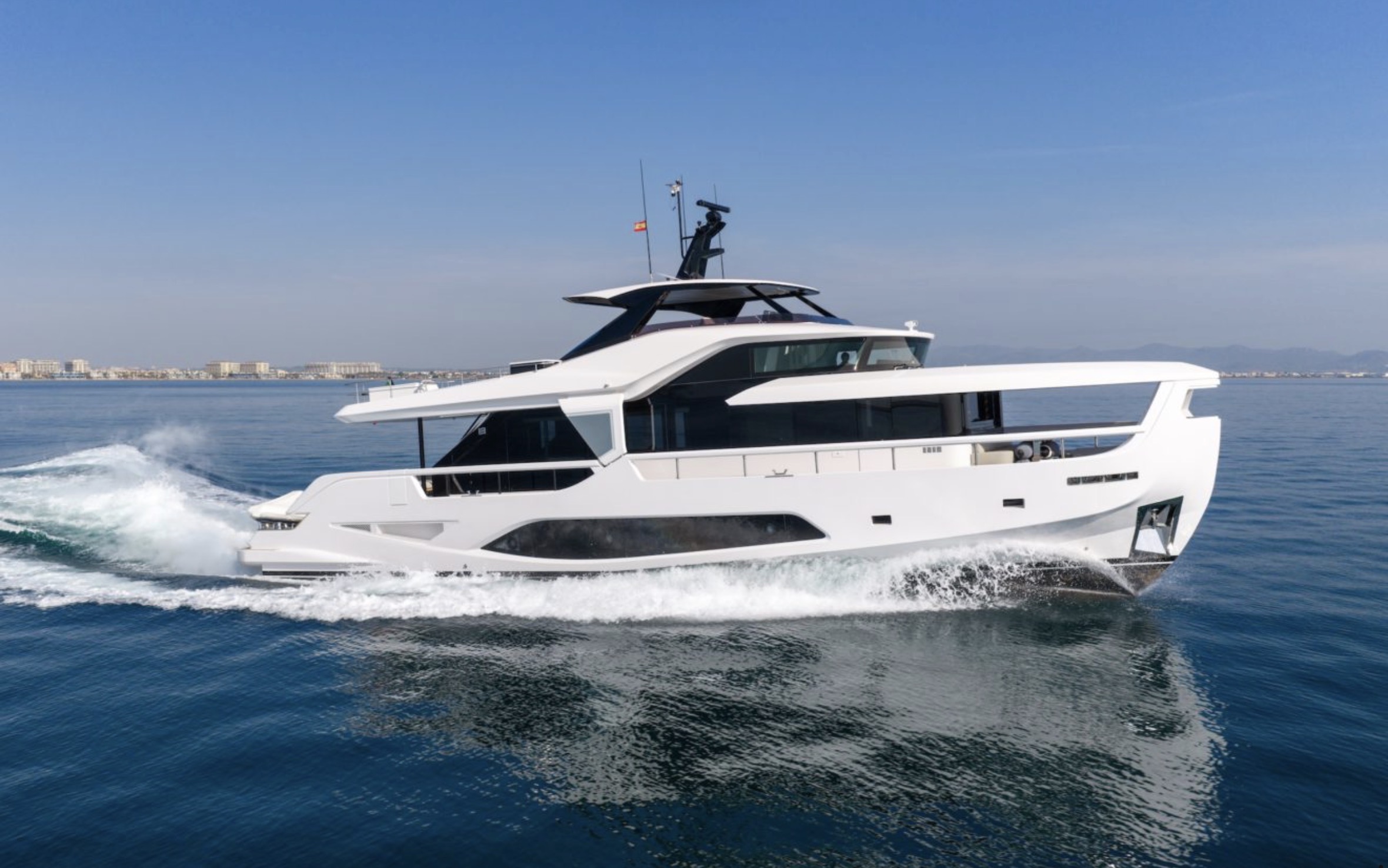
For most of yachting history, progress was measured in a fairly narrow way: a few more feet of length, a few more knots of top speed, a slightly larger engine room. That era is quietly ending. The yachts now leaving the world’s leading yards are being judged less by brute specification and more by how intelligently they are conceived — how efficiently they run, how fluidly their spaces move between inside and outside, and how thoughtfully every surface a guest touches has been considered. The future of yacht living is not a single technology or a single aesthetic. It is a shift in what owners now expect a yacht to be: quieter, cleaner, more open, and more personal than the generation before it.
A New Generation of Yachts
The most visible change is happening below the waterline and inside the engine room. Hybrid and electric propulsion systems, once confined to concept renderings, are now appearing on production vessels, reducing fuel consumption and, just as importantly, the noise and vibration that used to be accepted as the cost of covering distance under power. Battery technology has matured to the point where silent running at anchor — no generator hum, no diesel smell — is becoming a genuine selling point rather than a novelty. This shift was on full display at the most recent Cannes Yachting Festival, where energy sobriety and hybrid boating dominated the conversation among builders and buyers alike.
Sustainable materials are advancing in parallel. Recycled composites, responsibly sourced teak alternatives, and lighter-weight hull construction are reducing both environmental impact and overall vessel weight, which in turn improves efficiency further. Perhaps the clearest sign of where the market is heading is the rise of the modern yacht built smaller and smarter rather than simply bigger — compact platforms that deliver genuine luxury with a fraction of the running cost and environmental footprint of the vessels that used to define the category. What once looked like a compromise is increasingly treated as the more sophisticated choice. Onboard systems have followed the same trajectory: integrated digital platforms now let a single interface manage climate, lighting, navigation data, and entertainment, replacing the maze of separate panels that used to clutter a bridge or a saloon wall. The effect is a vessel that feels less like a collection of machinery to operate and more like an environment that quietly adapts to the people aboard it.
Designing for Life at Sea
Technology is only half the story; the other half is architecture. The strict separation between a yacht’s interior and its exterior — walls, doors, fixed glazing — is dissolving in favor of spaces designed to flow into one another. Expansive terraces that fold out from the main deck, convertible lounges that shift from enclosed salon to open-air entertaining space within minutes, and fold-down beach clubs that turn the transom into a private waterfront have become some of the most requested features in new builds. The result is a yacht that behaves less like a vessel with a few outdoor areas and more like a floating villa where the boundary between inside and outside is a matter of preference, not fixed design.
This panoramic approach extends to natural light as much as to layout. Full-height glazing, retractable skylights, and open-plan decks are replacing the smaller portholes and compartmentalized cabins of earlier generations, letting guests stay connected to the horizon even while below deck. Much of this thinking traces back to design houses that have spent decades refining the relationship between a vessel’s structure and the way people actually want to live aboard it — an approach rooted in the same sensibility behind Italy’s enduring influence over yacht architecture, where proportion and openness have always mattered as much as engineering. Even the materials chosen for these indoor-outdoor spaces now reflect that priority: teak decking that stays cool underfoot, retractable shading that adjusts automatically with the sun, and glass treated to cut glare without dulling the view all exist to keep a terrace usable, not just photogenic, across an entire day at anchor.
The Details That Define Luxury
Once the architecture is right, luxury becomes a matter of detail — and increasingly, of restraint rather than excess. Bespoke materials selected for texture and tactility, intelligent lighting systems that shift tone and intensity throughout the day, and custom-built furniture scaled precisely to a yacht’s unusual proportions all contribute to an atmosphere that off-the-shelf fittings simply cannot replicate. The best cabins today feel less like a hotel suite transplanted onto a hull and more like a considered, singular space that could only exist on that particular vessel.
This is where interior design earns its place as a discipline in its own right rather than a finishing touch applied at the end of a build. Choosing materials and furnishings for a yacht is not the same exercise as decorating a home ashore: every surface has to withstand salt air, movement, and intense sunlight while still feeling warm and personal. Designers who understand this constraint are able to turn it into a signature — a palette of materials and a lighting scheme that reads as calm, confident, and unmistakably considered, rather than simply expensive. Even the smallest fittings now carry this intention — cabinetry hardware sized for a hand reaching out during a gentle swell, fabrics chosen for how they age under constant sun rather than how they look on day one, and joinery finished to a standard closer to fine furniture than marine fit-out.
Where Yachting Is Heading
Taken together, these three shifts — cleaner propulsion and smarter construction, architecture built around openness rather than enclosure, and interiors treated as a serious design discipline — describe a yacht that is fundamentally more livable than the ones that came before it. The future of yacht living is not about adding more; it is about designing with greater intention, so that every system, every terrace, and every detail serves the way people actually want to spend their time on the water.